
High cost of acquisition due to a variety of reasons, including higher GST than all other major countries, is slowing down car demand in the country and unless the Centre and states take steps to reduce it, the industry is unlikely to experience reasonable growth, according to Maruti Suzuki India Chairman R C Bhargava. Addressing shareholders in the company's Annual Report for 2020-21, he said after the devastating second wave of the coronavirus pandemic hitting the first quarter of FY22, the performance in the next three quarters will largely depend on how effectively people get vaccinated and observe safety protocols.

Of the 15 car manufacturing companies in India, eight have a market share of below 2 per cent, raising questions about their long-term future in a competitive market that has already seen Ford Motors and General Motors slam the door on India.

Maruti's exports in May were down 2.4% at 9,089 units

The car we're driving today is the most affordable Toyota in India, the Etios Liva and we tell you if you should consider it if you're in the market looking for a hatchback or look at the other obvious options.

The stock of the country's largest passenger vehicle maker, Maruti Suzuki India (MSIL), has been hitting successive all-time highs over the past three trading sessions. The rally in the scrip has helped it notch over a 21 per cent gain since the start of February, outperforming the National Stock Exchange Nifty Auto Index. The gains for the leader of small passenger cars have been more recent, as the company still trails the Nifty Auto over one- and two-year periods.

The industry needs stimuli to help revive consumer demand and conversions.

Beginning with a bang amid all the glitz and glamour of the biennial Auto Expo, the year will be ending with a whimper for the automobile industry as sales dwindle, and the worst-ever industrial violence at Maruti Suzuki's Manesar plant leaves a big scar.

Auto loan costs remain stubbornly high.

Driven by strong demand, the overall passenger vehicle dispatches crossed 3.35 lakh units in February as automakers, including Maruti Suzuki India, Hyundai, Tata Motors and Mahindra & Mahindra, reported robust sales during the month. The dispatches of more than 3.35 lakh units last month marked an 11 per cent over February 2022. It was also the highest ever overall wholesales in the month of February. The country's largest carmaker Maruti Suzuki India on Wednesday said its domestic wholesales rose 11 per cent to 155,114 units in February as compared with 140,035 units in the same month last year.

India's electric mobility goal, which has so far been riding on two wheels, is all set to graduate to four wheels. At least, the journey has begun. Hyundai Motor India said it would invest Rs 4,000 crore till 2028 to launch half-a-dozen electric vehicles (EVs) in India. It would eventually straddle premium and mass segments. The first of these - the electrified version of an internal combustion engine (ICE)-powered model - will go on sale as early as next year.

Maruti Suzuki, Hyundai and Mahindra failed to register significant growth.

Car makers are trying hard to boost sales in India.

During September, Maruti said it dispatched 1,375 units of the soon-to-be-launched sedan Ciaz.

While two-wheeler sales declined 22 per cent, two other segments, bigger in value while being lower in volume, were much less impacted.

Passenger vehicle sales continue to drop in June; Maruti, Hyundai, Tata Motors, Toyota witness decline. Mahindra & Mahindra, however, reported a 4 per cent growth.

Maruti, Hyundai & Mahindra together had 72.5% market share in year's first half.

Exports in August were up 10.3 per cent to 12,472 units from 11,305 units in the same month of previous year.

Hero MotoCorp, Honda Motorcycles, Scooters India, TVS, Honda India, Toyota Kirloskar Motor, Ford, Nissan, Ashok Leyland are all giving the Auto Expo a miss this time.

Consumer sentiments have been dampened due to several factors like tight liquidity, high insurance, and high costs

The edge that Maruti Suzuki enjoys over Hyundai and other rivals stem primarily from its gigantic scale, reports Ajay Modi.

M&M also saw its domestic passenger vehicle sales grow by 1 per cent, while Toyota Kirloskar Motor witnessed a decline in its PV sales.
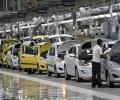
Data available from top six players - Maruti Suzuki, Hyundai, M&M, Tata Motors, Honda and Toyota - shows an average growth of about 42 per cent for the industry in June

http://im.rediff.com/money/2023/jul/20uv.jpg

'More than one brand in a showroom is too risky because customer loyalty in this market is low. Most people don't drive different cars made by the same manufacturer for a lifetime, they experiment.'

India is sceptical that Tesla might import into the country cars made in China. Tesla executives were in India last month and appear to have proposed a factory in the country. But do not be surprised if that does not happen in a hurry.

The recall will affect 2,910 units of the sedan version of Sail and 1,090 units of compact car variant of the model.
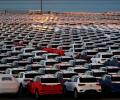
Reflecting the mood, passenger vehicle sales in November either remained muted or skidded for most manufacturers as high fuel prices and the higher cost of borrowing dampened buying sentiment.

'Some of the launches may get deferred due to the semiconductor shortage, which is unlikely to get resolved before the second half of 2022.'

Experts attribute the high valuation of Indian auto makers to the faster growth in India compared to the rest of the world.

Besides their country of origin, General Motors, Ford Motor and Harley-Davidson have another trait in common: all three have failed in India, the world's fifth largest automobile market. All three of them took a tough call to de-prioritise India as a market amid disruption from heightened regulations and sharper focus on capital allocation by the parent.

Close to 50 models were launched in India in the past 12 months, but companies have not been able to realise their potential due to the pandemic.

Maruti, Hyundai, Tata Motors, Mahindra & Mahindra and Honda saw their passenger vehicle sales improve in August compared to the same month last year, although Ford and Toyota witnessed a decline.

With a new chief executive officer (CEO) at the helm, the country's largest two-wheeler maker Hero MotoCorp is now looking to cut flab and move towards a leaner organisation. It has launched a voluntary retirement scheme (VRS) for its staff as it aims to make the organisation 'agile and future-ready'. Recently, the company's erstwhile chief financial officer (CFO) Niranjan Gupta was elevated as CEO.

Benchmark equity indices Sensex and Nifty closed higher on Friday after two days of fall, helped by buying in metal, telecom and auto stocks amid a firm trend in global markets. Automakers led by Maruti Suzuki India, Hyundai, Mahindra & Mahindra reporting robust wholesales of passenger vehicles and GST collections crossing Rs 1.50 lakh crore for the third straight month in May also added to the optimism. The 30-share BSE Sensex climbed 118.57 points or 0.19 per cent to settle at 62,547.11.

India's flagship motor show Auto Expo 2023 kicked off on Wednesday with the global unveiling of Suzuki Motor Corporation's concept electric SUV 'eVX' which is slated to hit the market by 2025. The company's Indian arm Maruti Suzuki India is among the major manufacturers participating in the show that has returned after three years. The Concept eVX is a mid-size electric SUV concept designed and developed by Suzuki Motor Corporation (SMC), Japan. It will be powered by a 60 kWh battery pack offering up to 550 km of driving range on single charge.

The limited availability of flexible (flex)-fuel vehicles in the Indian market and the slow rollout of ethanol-blended petrol by oil-marketing companies (OMCs) remain major obstacles to achieving widespread use of biofuels in the transportation sector in India. Recently, two Union ministers have emphasised India's biofuel potential, arguing that it has the capacity and potential to lead a transition towards widespread biofuel adoption. Road Transport Minister Nitin Gadkari signalled that this transition is well underway and urged car manufacturers to quickly adapt and introduce new biofuel-run vehicles, lest the government resort to taxing diesel vehicles.

Maruti Suzuki, Hyundai, Mahindra and Toyota reported low single-digit sales growth for the month owing to weak market sentiment

For players like Toyota Kirloskar and Ford, the contribution of UVs to overall sales is now well over 60%.

Car sales are likely to grow further in November.

In October, the company had launched Ciaz in both petrol and diesel options.
 © 2026 Rediff.com - Advertise with us - Disclaimer - Privacy Policy - Sitemap - Feedback - About us - Terms of use - Grievances